
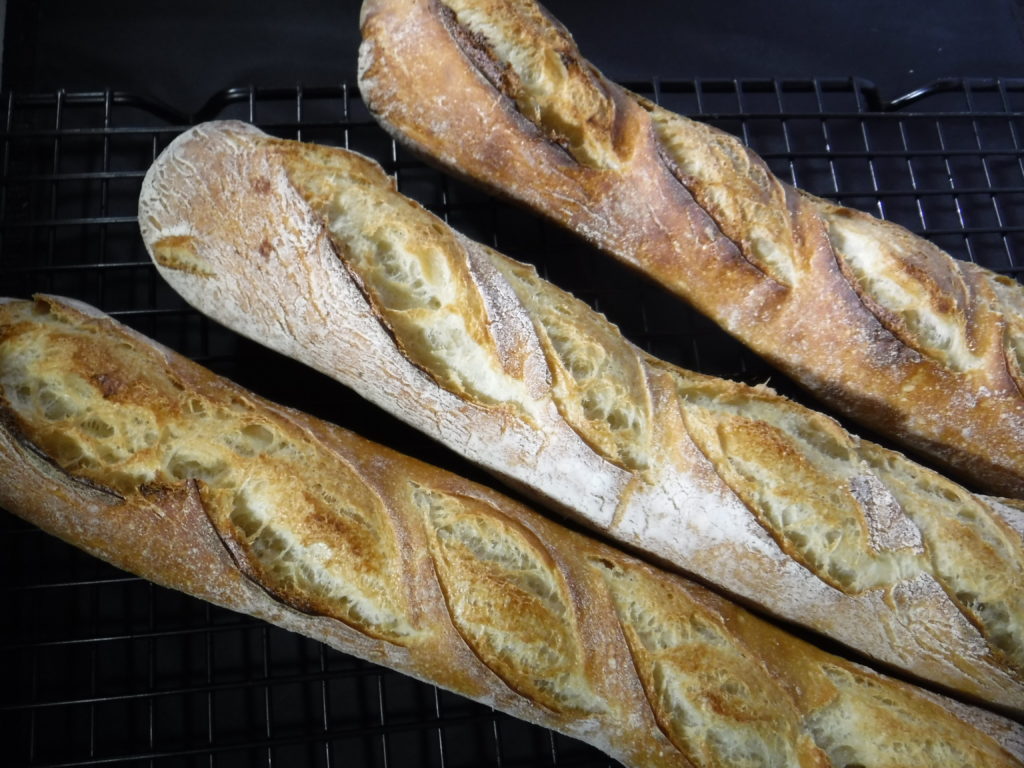
This is a variation of Sourdough Baguettes replacing part of the all-purpose flour with KTA Keto Flour to increase the amount of fiber in the bread while preserving its flavor as a white bread. I refreshed my 50-50 sourdough starter on the morning of 12/29 and in the afternoon built it up to the quantity I needed for 1.5 recipes. On 12/30 I made the dough through step D5 in the time-table below and let it rise overnight in the refrigerator. On 12/31, I divided the dough 1/3 vs. 2/3 and used the 1/3 to make a baguette for New Year’s Eve, returning the remaining 2/3 of the dough to the refrigerator. On the morning of 12/31, I divided the remaining dough into 2 pieces and baked 2 baguettes for the New Year’s Day / Alyssa’s Birthday dinner.
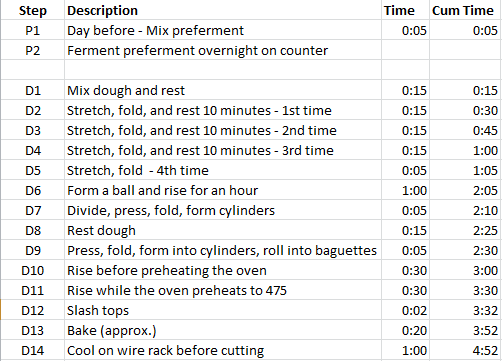
The following time-table summarizes the steps and how much time a batch of bread will take. The preferment needs to start on at least 1 day before the bread is baked. The D steps can all be done on 1 day or can be divided over 2 days, with the logical breaking point being after D5
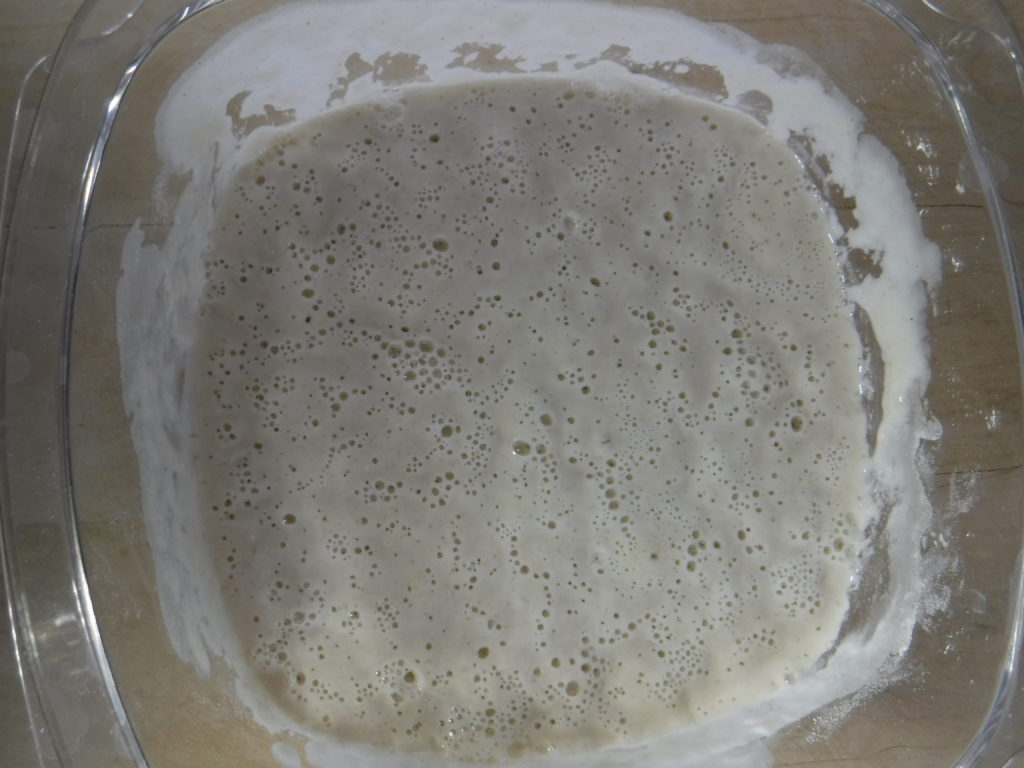
The night before baking, take 100 g. of the sourdough starter, and add 75 g. of all-purpose flour and 75 g. of room temperature water. (Replenish the starter at least weekly with equal weights of all-purpose flour and water and store in the refrigerator.) Mix well with a spoon or dough whisk, cover loosely, and leave on the counter to ferment overnight. Here is the starter when it is ready to be used to bake.
The ingredients for a baguette are very simple. It is all about technique. This recipe will make 3 baguettes weighing about 230 grams (~8 oz.) each. See notes at the bottom about making larger quantities.
250 g. sourdough starter (100% hydration)
225 g. all purpose flour
75 g. KFA Keto Blend (Or equivalent from Bob’s Red Mill)
1.25 tsp. salt
¼ tsp. yeast
160 g. (160 ml) lukewarm water (More water than if only all-purpose flour is used)
In a medium bowl, mix together the flours, salt, and yeast, and then mix in the sourdough starter and the water using a dough whisk. Mix until a reasonably smooth dough is created.
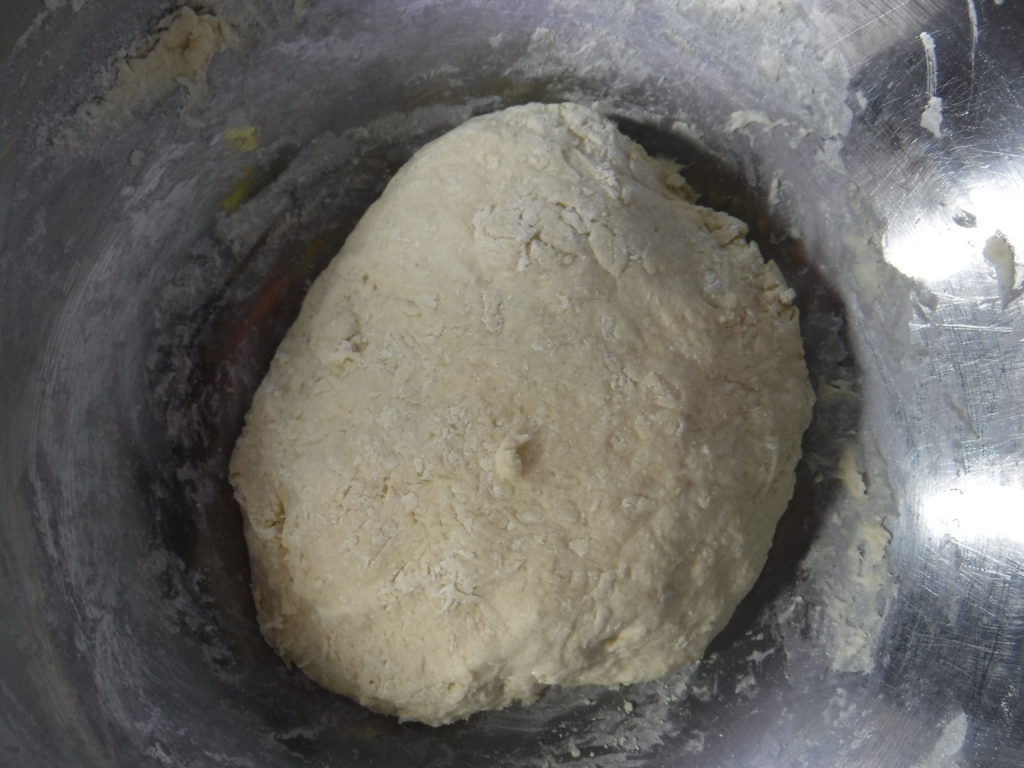
Cover, and rest for 10 minutes,and then with moistened fingers, stretch and fold the dough for about 30 seconds. Rest for another 10 minutes,and then stretch and fold again. Repeat a total of 4 times, by which time the dough should be a smooth ball.
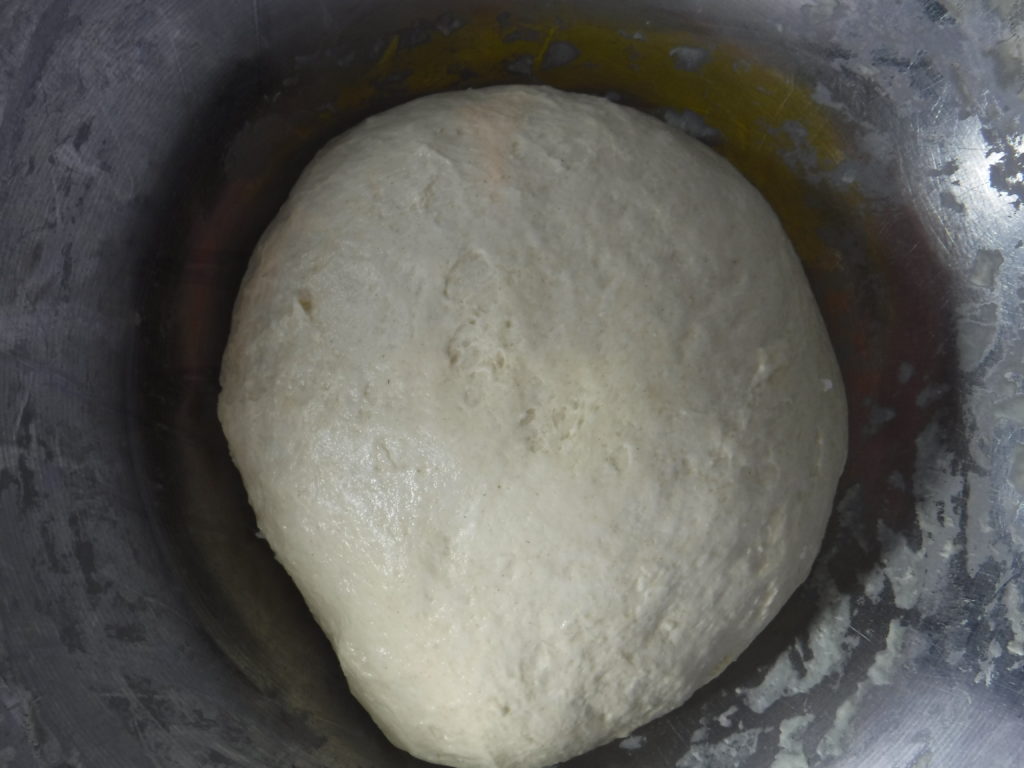
Place the dough ball in a bowl, cover, and allow to rise for an hour until doubled
The original recipe called for dividing the dough into three parts, but lately I have been making two larger loaves (each one about 345 g.). If dividing in two, use a dough knife. If dividing in three, use the scale since it is harder to do. (My small dough doubler weighs 168 grams. Thus the first easy step is to weigh the entire batch of dough, subtract the weight of the container, and divide by 3 to get the target weight for each baguette.)
Working on a lightly floured surface, pat each piece into a rectangle. Fold the right side to the middle and then the left side to the middle. Pat down. Fold the top third of the dough into the middle, pressing the dough together with fingertips. Rotate 180 degrees and repeat with the third which had formerly been on the bottom. In the end, you should have a nice cylinder. Repeat with the remaining dough. Cover with a towel and rest for 15 minutes.
Working on the lightly floured surface, take one of the cylinders, put it seam side up, and put it into a rectangle. Again fold the top third to the middle, pressing the dough together, and then do the same with the bottom third. Press the seam together. Using both hands, roll the dough back and forth, elongating it until you have the desired length. Repeat with the remaining cylinder(s).
Put the dough in a floured couche, with folds between each piece, and cover with the rest of the couche.
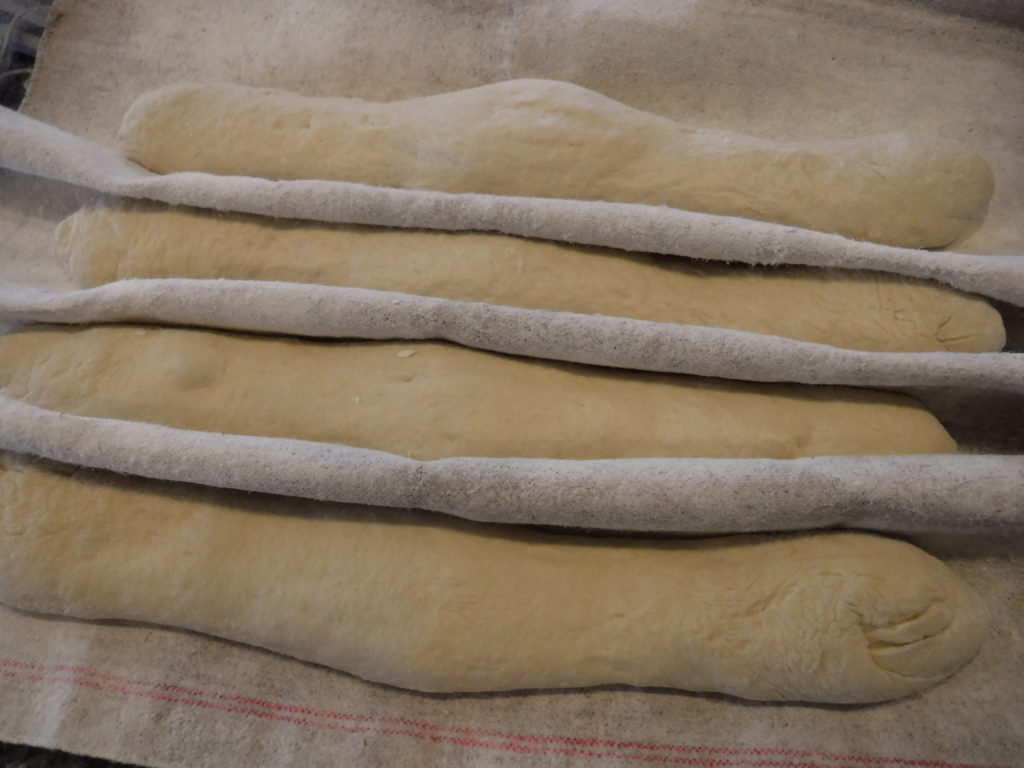
Rest until doubled, about an hour.
About 30 minutes before baking, position a baking steel or stone in the middle of the oven, and a heavy ovenproof pan, such as a cast iron frying pan, in the lower third of the oven. Preheat the oven to 475 degrees. Heat about a cup of water to boiling.
Carefully transfer the risen loaves to a sheet of baking parchment on a peel (seam side down), degassing them as little as possible. Using a lame or sharp knife, score the top 5 times in overlapping parallel slashes. Put the loaves on the baking steel or stone. Pour the boiling water into the hot pan at the bottom of the oven, being careful not to be scalded by the steam. Immediately shut the oven door. Bake for 18-22 minutes if divided into two loaves (15-19 minutes if divided into three loaves) until the bread is golden brown. Remove to a rack and allow to cool for an hour before eating.
Notes for larger quantities
For a family party of 12 adults and 4 small children, I multiplied the recipe by 4, and formed the dough into 6 baguettes, each of which was double the size of the baguettes in the base recipe. I really needed slightly less than 5 of these loaves.
The major technique change is that I mixed the dough in the stand mixer with the dough hook until I had a fairly smooth dough. I baked them in two batches of 3 loaves each. Getting the larger doughs in and out of the oven was a bit of a challenge. They needed to go into the oven sideways to fit the baking steel. They were too big for my peel, so I ended up using the back of a cookie sheet and baking parchment to get them one by one into the oven. The process was a bit messy, but the final loaves turned out well. Since the loaves were bigger, they needed to be baked longer. 22 minutes worked well.